The 5th Iconicity Seminar (IcoSem5) will be held in Daejeon, South Korea on 1–3 April 2027.
Call for papers
IcoSem5 invites abstracts that pertain to linguistic iconicity, the resemblance between linguistic form and meaning.
We call for papers for 30-minute presentations (20min presentation + 10min Q&A) dealing with any aspect of linguistic iconicity, such as:
- Sound symbolism
- Onomatopoeia and ideophones
- Sign language iconicity
- Syntactic iconicity
- Iconicity and language change
- Iconicity in writing systems
- Phonaesthetics
- Phonaesthemes
Please send a 2-page abstract (including everything) in the following format:
- A4 paper
- 2.5cm margin
- 12pt Times New Roman
Please send your abstract to joo@res.otaru-uc.ac.jp. It will then be reviewed by the organizer.
The extended deadline is 31 October 2026. Decisions will be communicated to you on a rolling basis within two weeks after the submission (and not necessarily after the deadline). We thus encourage you to submit as soon as your abstract is ready so that you can plan your trip well in advance.
Accepted papers (so far)
- Lexicological salience in ideophone semantics: Toward an onomasiological turn (Thomas Van Hoey)
- A Multi-Level Iconicity Analysis of Ashkanani’s Ḩusayni Elegy “Yā Muṣḥaf Ma’sātī” (Maha Lafta Marzook)
- When is a phonestheme iconic? Tracking English fl- and sw- networks across frequency, polysemy and time (Chris A. Smith)
- One-to-many and many-to-one form-meaning mappings in entity classifiers across signed languages (Vanessa Wing Yan Tsang)
- Hidden words, visible patterns: Preliminary investigation (Victoria Bogushevskaya)
- Iconicity in Character Signs used in East Asian Sign Languages (James H. -Y. Tai)
- Phonological and Prosodic Markedness in Jejuan and Korean Ideophones (Joo Yun Roh)
- Cross-linguistic evidence for the Attentional Optimization Hypothesis (Alexander Kilpatrick & Rikke Bundgaard-Nielsen)
- Swearwords and the information-theoretic structure of phonological word forms (Kensuke Inoue & Alexander Kilpatrick)
- Iconicity in Vietnamese Deformation Ideophones (Tang Thi Tuyet Mai)
- Relational Iconicity and Its Limits in Chinese Four-Character Idioms (Sina Nemati)
- When complex syllables are soft and round, but in an unpleasant way: What newly created languages can tell us about the phonaesthetics of syllable structure (Simon David Stein)
- On Chinese iconicity and second language vocabulary acquisition (Huichen Hsiao)
- The perception of iconicity in International Sign versus Taiwan Sign Language (Jane Tsay)
- Iconicity in Spanish Evaluative Verbs (Rawaa Almheiri)
- Viewpoint in event narratives: A cross-modal comparison of Gã and Hong Kong Sign (Josiah Nii Ashie Neequaye and Vanessa Wing Yan Tsang)
- When is reduplication no longer iconic? A corpus-phonetic study of Korean ideophones (Seungjoon Cho and Sung Do Kim)
- From parallelism to non-parallelism: Syntactic–semantic correspondence in Classical Chinese prose (Shih-Wen Chyu)
- Reversal iconicity in Daoist inner alchemical discourse: Form–meaning mapping in the Cantong qi, Wuzhen pian, and Zhong-Lü chuandao ji (Rongguan Dai)
- Embodied iconicity and gestural accommodation in migration: An exploratory study of Japanese and Italian migrants’ perceptions in Germany (Juliana Neves-Müller and Rolf Kailuweit)
- Sound-imitating and sound-symbolic words in Arabic, Urdu and Pashto: from everyday sounds to the vocabulary of pain (Sunila Gohar and Numan Ali)
- Depicting motion in Ch’orti’ Maya: Ideophones in a morphologically integrated predicate class (Kerry Hull)
Format of the conference
IcoSem5 is an in-person conference without virtual participation, although some virtual presentations may be permitted in exceptional cases.
The language of the conference is English. Live captions in English will be provided during the presentations.
Participation fee
The participation fee is 50,000 Korean won for student presenters and 100,000 won for non-student presenters. It is free for non-presenting auditors.
The fee is waived for participants studying or working at a institution of a low income or lower middle income country (as defined by World Bank).
Venue
The conference will be held at the Daejeon Convention Center.
About Daejeon
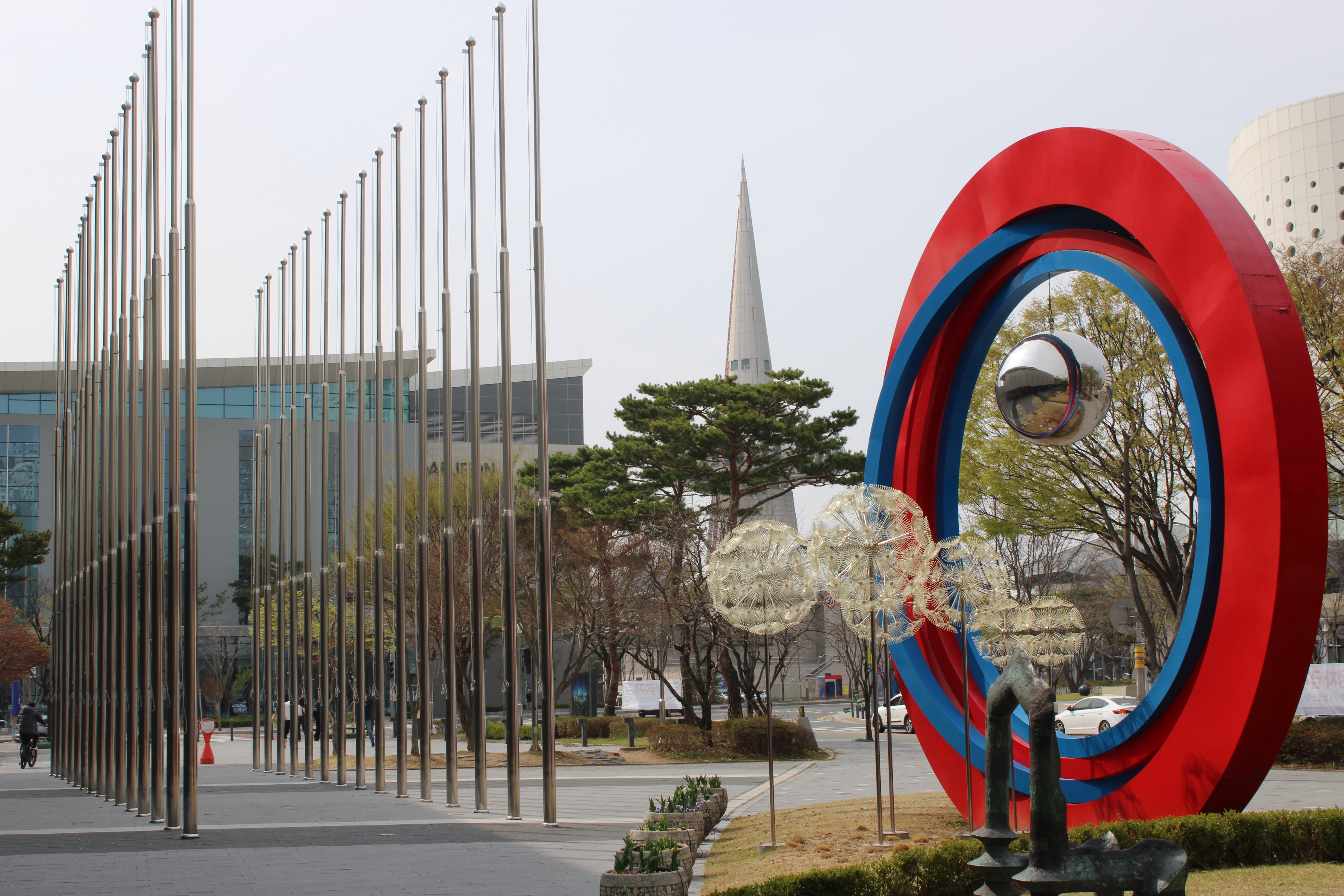
Daejeon [tʰè.d͡ʑʌn] is a city located in central South Korea, easily accessible from Seoul or Busan.
The available international airports are:
- Incheon International Airport (Incheon) - 2.5 hours to Daejeon
- Gimpo International Airport (Seoul) - 1.5 hour
- Gimhae International Airport (Busan) - 2 hours
- Daegu International Airport (Daegu) - 1 hour
- Cheongju International Airport (Cheongju) - 1 hour
The attractions in Daejeon include:
- Sung Sim Dang - The most famous bakery in Korea
- Daejeon Expo Park - The conference venue is right next to this park
- Yuseong Foot Spa - Soak your feet in a public hot spring
The first week of April is the cherry blossom season in South Korea. While the specific blooming times vary each year, participants may be able to enjoy the blooming flowers in Daejeon.
Seoul is only an hour away and Busan 1.5 hour away from Daejeon by high speed rail, making a day trip easily possible.
Links
Join our Facebook group for iconicity